
Saudi occupational safety and health requirements form an important part of the Kingdom’s workplace safety and health framework. These requirements are supported by regulations, policies, guidance, and inspection mechanisms issued by Saudi government authorities, including the National Council for Occupational Safety and Health (NCOSH).
Organizations should identify the Saudi occupational safety and health requirements applicable to their specific activities, workforce, workplace, and industry rather than relying on a single general safety document.
This guide provides a practical overview for employers, HSE professionals, supervisors and workers. It is not a replacement for the applicable Saudi laws or official regulatory documents.
Saudi Occupational Safety and Health Requirements Framework
Saudi Arabia’s OSH framework includes both general workplace requirements and regulations addressing specific risks, activities and occupational groups.
The current NCOSH library includes, among other resources:
- Occupational Safety and Health Regulations
- Employer Compliance Guide
- Occupational Safety and Health Inspection Mechanism
- National Occupational Safety and Health Policy
- Regulations for Work in High-Risk Occupations
- Occupational Fitness and Non-Communicable Disease Regulations
- Regulations for licensing and accreditation of OSH practitioners and service providers
- Guidance for construction, excavation, scaffolding and industrial hazards
- Heat-stress and hot-environment guidance
Organizations should identify the Saudi occupational safety and health requirements applicable to their specific activities, workforce, workplace and industry.
Key Employer Responsibilities
Saudi occupational safety requirements place important responsibilities on employers to protect workers from occupational hazards.
Depending on the applicable requirements and workplace activities, employers should establish appropriate arrangements for:
- Preventing and controlling occupational hazards
- Providing safe working conditions
- Identifying and managing workplace risks
- Providing appropriate safety information and instructions
- Implementing preventive and protective measures
- Providing appropriate personal protective equipment where required
- Maintaining suitable emergency arrangements
- Monitoring workplace safety performance
- Addressing identified safety deficiencies
The official NCOSH framework also includes an Employer Compliance Guide and an OSH Inspection Mechanism, supporting organizations in understanding and evaluating compliance.
Specific obligations can vary according to the workplace, activity, workforce and applicable regulation. Employers should regularly review applicable Saudi occupational safety and health requirements to ensure that workplace controls remain aligned with current regulatory expectations.
Worker Responsibilities
Workers also have an important role in maintaining workplace safety.
Practical expectations may include:
- Following applicable safety instructions
- Using required protective equipment correctly
- Reporting hazards and unsafe conditions
- Cooperating with safety procedures
- Participating in required safety activities
- Avoiding actions that could create unnecessary risks to themselves or others
The exact legal duties of workers should be determined from the applicable Saudi legislation and regulations.
Risk Prevention and Workplace Controls
Effective Saudi OSH compliance should focus on preventing hazards rather than responding only after incidents occur.
For construction and industrial workplaces, organizations should consider hazards associated with activities such as:
- Work at height
- Lifting operations
- Excavation
- Scaffolding
- Heavy equipment
- Electrical work
- Hazardous substances
- Heat exposure
- Workplace traffic
- Machinery and industrial activities
NCOSH currently provides dedicated guidance for areas including construction sites, excavation, scaffolding and industrial hazards.
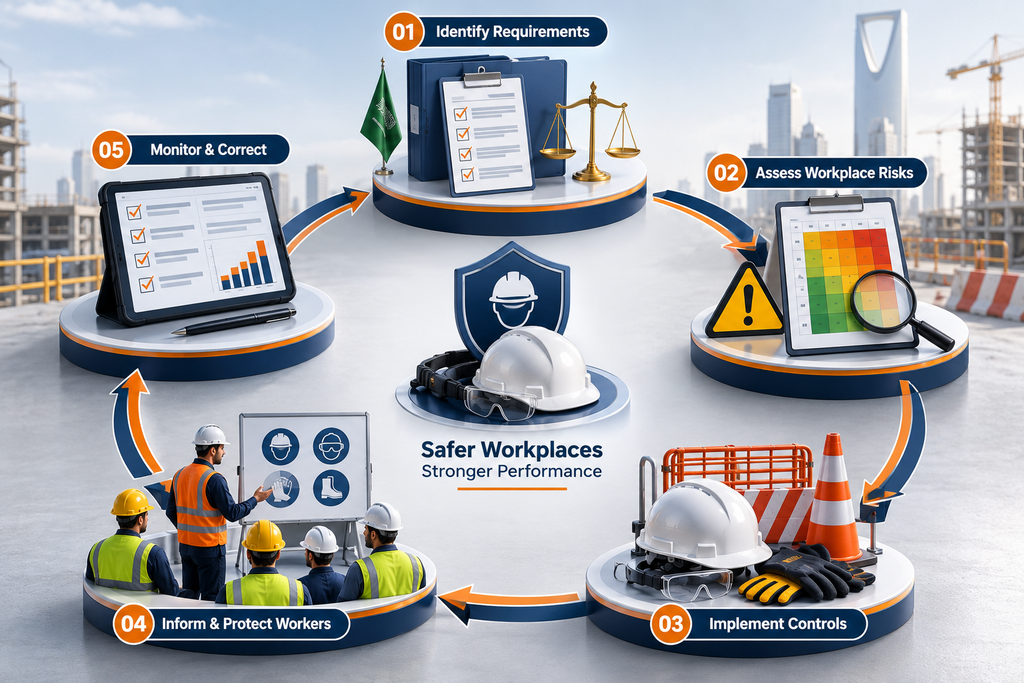
Practical HSE interpretation
A useful compliance approach is:
Identify hazards → Assess risks → Implement controls → Communicate requirements → Monitor → Correct deficiencies → Review
This helps connect regulatory requirements with actual workplace conditions.
High-Risk Occupations
Saudi Arabia has specific regulations addressing work in high-risk occupations.
The official regulation establishes a framework concerning the classification and licensing of high-risk occupations and addresses qualifications, responsibilities, training, monitoring and enforcement.
Organizations involved in high-risk activities should therefore verify whether specific occupational licensing, qualification or other regulatory requirements apply to their workers and activities.
Do not assume that a general HSE training certificate automatically satisfies a specific regulatory qualification requirement.
Practical HSE Compliance Checklist
Use the following as a quick internal verification tool:
- Applicable Saudi OSH requirements have been identified.
- Workplace hazards have been assessed.
- Appropriate preventive controls are implemented.
- Workers receive relevant safety information and instructions.
- Required PPE is provided and properly used.
- Emergency arrangements are established.
- Safety inspections are conducted.
- Identified deficiencies are corrected and tracked.
- Applicable worker competency or qualification requirements are verified.
- Regulatory changes are periodically reviewed.
Note: This is a practical TheHSEVerse checklist. It is not an official Saudi government compliance checklist.
Related HSE Resources
- HSE Observation Report Form — supports recording and tracking unsafe conditions and corrective actions.
- Construction Site Risk Assessment — connects Saudi OSH requirements with practical hazard identification and risk control.
- Construction Site Safety Inspection Checklist — useful for workplace compliance verification.
Official Saudi References
National Council for Occupational Safety and Health — Rules & Regulations
NCOSH Official Rules & Regulations Library
NCOSH — Administrative Systems and Regulations
NCOSH Administrative Systems and Regulations
These official pages provide access to current Saudi OSH regulations, decisions, guides and other regulatory material.
Last Reviewed
August 2026
This resource was reviewed against the current official NCOSH regulatory library available at the time of publication.
Disclaimer
This TheHSEVerse resource is an independent educational and practical guide. It is not an official Saudi regulation and does not replace applicable Saudi legislation, regulations, ministerial decisions or official guidance.
Requirements may vary according to the activity, workplace, sector and circumstances. Always consult the current official Saudi source before making specific legal or compliance decisions.