
A practical Construction Site Safety Inspection Checklist designed to help HSE professionals, supervisors, engineers, consultants, and site management systematically inspect construction activities and identify unsafe conditions, unsafe practices, and gaps in safety controls.
This checklist provides a structured approach for routine site inspections, contractor inspections, weekly HSE inspections, management inspections, and construction safety audits.
The complete downloadable checklist contains 120 inspection points covering the major safety areas of an active construction site.
What Does This Construction Safety Checklist Cover?
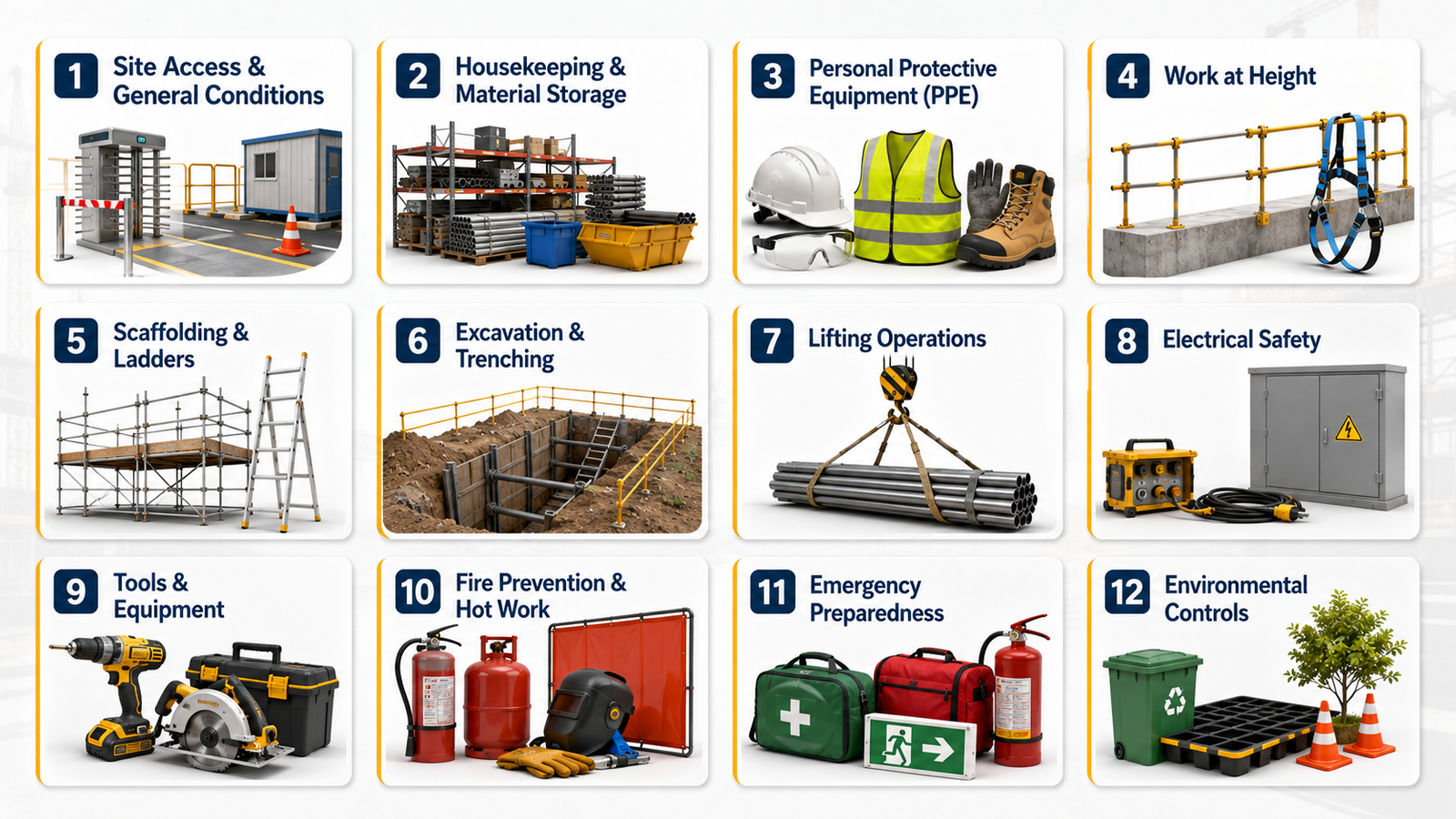
The checklist is organized into 12 key inspection sections:
1. Site Access & General Conditions
Covers site access, pedestrian routes, traffic routes, barricades, signage, lighting, trip hazards, site boundaries, and emergency access.
2. Housekeeping & Material Storage
Covers workplace cleanliness, waste management, material stacking, storage areas, combustible materials, and access routes.
3. Personal Protective Equipment (PPE)
Covers helmets, safety footwear, high-visibility clothing, eye protection, hand protection, hearing protection, respiratory protection, and fall protection.
4. Work at Height
Covers work-at-height planning, working platforms, edge protection, floor openings, fall protection, anchor points, falling-object prevention, exclusion zones, and weather conditions.
5. Scaffolding & Ladders
Covers scaffold erection, access, platforms, guardrails, toe boards, foundations, inspections, scaffold tagging, ladder condition, and safe ladder use.
6. Excavation & Trenching
Covers excavation planning, underground utilities, protective systems, competent-person inspections, access and egress, barricading, spoil placement, plant proximity, water accumulation, and unauthorized access.
7. Lifting Operations
Covers lifting planning, cranes, lifting accessories, inspection, safe working loads, competent personnel, exclusion zones, suspended loads, and communication.
8. Electrical Safety
Covers temporary electrical installations, electrical panels, cables, plugs and sockets, grounding, residual-current protection, defective equipment, inspections, and electrical hazards.
9. Tools & Equipment
Covers hand tools, power tools, machine guards, equipment condition, operator authorization, mobile plant, safety devices, inspection records, and moving-part hazards.
10. Fire Prevention & Hot Work
Covers fire extinguishers, hot-work controls, combustible materials, fire watch, gas cylinders, hoses and regulators, smoking controls, and emergency fire access.
11. Emergency Preparedness
Covers emergency procedures, contact information, assembly points, emergency routes, first-aid facilities, first-aid supplies, trained first-aiders, emergency drills, rescue arrangements, and emergency access.
12. Environmental Controls
Covers waste segregation, hazardous waste, chemical storage, secondary containment, spill prevention, spill kits, dust control, wastewater management, and environmental incident reporting.
What Is Included in the Checklist?
The downloadable checklist includes:
- 120 practical inspection points
- Yes / No / N/A inspection format
- Remarks and corrective-action column
- Findings and observations register
- Risk level classification
- Corrective-action tracking
- Responsible person
- Target completion date
- Close-out status
- Overall site safety assessment
- Inspector sign-off
- Supervisor / responsible-person sign-off
Who Should Use This Checklist?
This construction safety inspection checklist can be used by:
- HSE Managers
- HSE Engineers
- HSE Officers
- Safety Supervisors
- Site Engineers
- Construction Managers
- Project Managers
- Consultants
- Contractor HSE Teams
- Site Supervisors
- Competent Inspectors
When Should You Use It?
The checklist can be used for:
- Routine construction site inspections
- Daily or weekly HSE inspections
- Contractor safety inspections
- Management safety walks
- Project HSE audits
- Pre-start inspections
- High-risk activity inspections
- Corrective-action verification
- Construction site safety monitoring
How to Use the Checklist
1. Complete the inspection information
Record the project, location, inspection date, inspector, contractor, and relevant site information.
2. Inspect each applicable item
Review each inspection point and mark Yes, No, or N/A based on the actual site condition.
3. Record non-compliances
Any item marked No should be supported with a clear remark, observation, or corrective action.
4. Record significant findings
Transfer important findings to the Findings & Corrective Actions section and assign a responsible person and target completion date.
5. Complete the overall assessment
Select the appropriate overall site safety status based on the inspection results.
6. Sign and retain the completed checklist
The inspector and responsible person should complete the sign-off section and retain the inspection record according to the project’s document-control requirements.
Download the Construction Site Safety Inspection Checklist
Get the complete 120-point Construction Site Safety Inspection Checklist for practical field use.
Available Formats
Download Editable DOCX Checklist
Related HSE Resources
Continue building your construction safety system with related TheHSEVerse resources:
Additional Guidance
Construction safety requirements should always be checked against applicable legislation and recognized safety standards. For additional guidance, users can refer to resources from organizations such as OSHA and the International Labour Organization (ILO).
Important Safety Disclaimer
This checklist is provided as a practical safety inspection aid and does not replace applicable legislation, regulatory requirements, project-specific HSE requirements, risk assessments, method statements, approved procedures, manufacturer instructions, or competent professional judgment.
Users should adapt the checklist to the specific project, activities, hazards, contractual requirements, and applicable legal and regulatory requirements.