
The Work at Height Safety Checklist is a practical inspection tool designed to help HSE professionals, supervisors, engineers, and competent persons verify essential controls before and during work at height.
Work at height can involve significant fall risks from scaffolds, ladders, roofs, platforms, open edges, floor openings, and other elevated work areas. Effective control starts with proper planning, risk assessment, competent workers, suitable equipment, and appropriate fall-prevention measures.
This checklist provides 30 practical inspection points covering the key controls required for safe work at height.
What Does This Work at Height Checklist Cover?
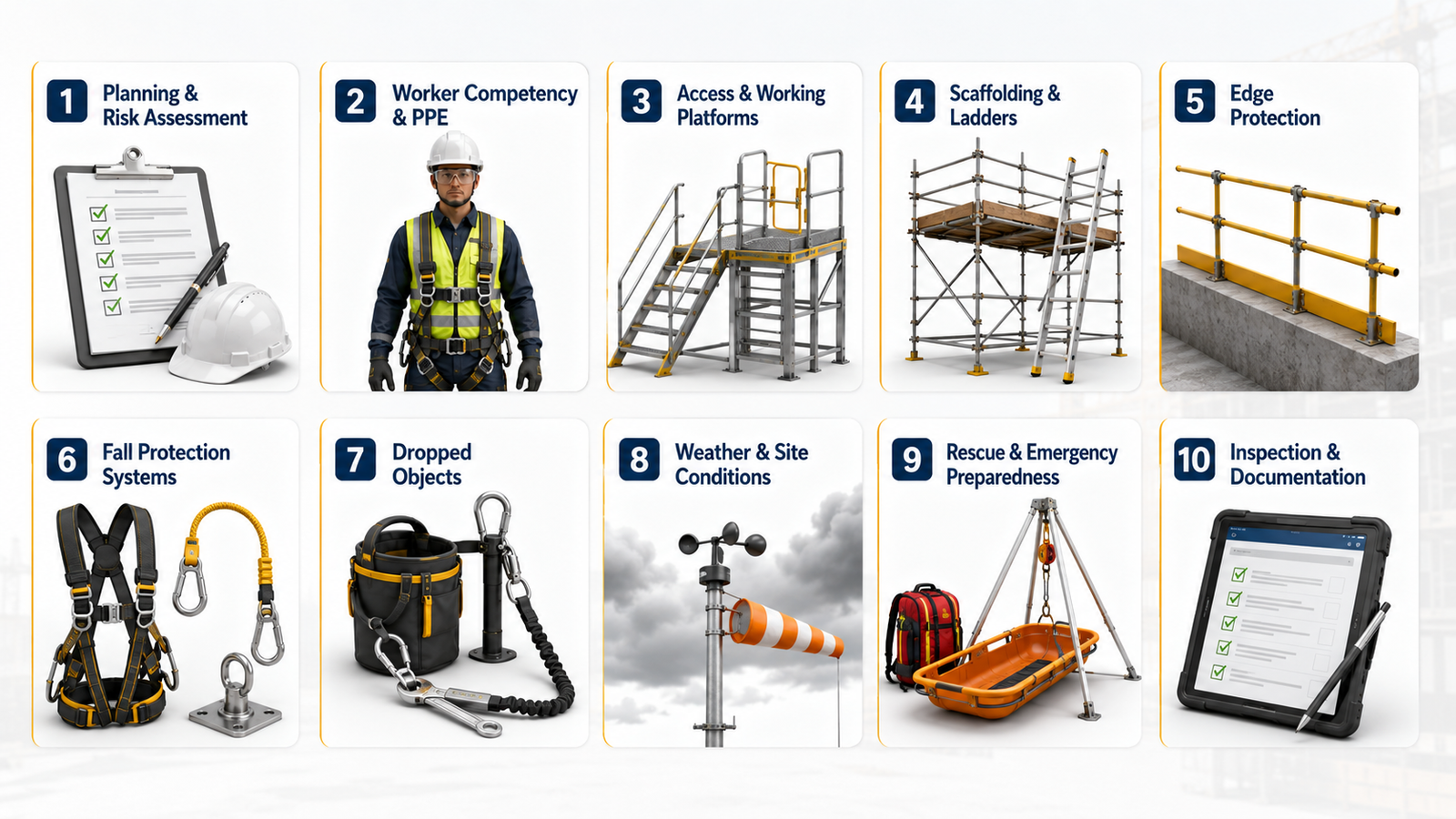
The checklist focuses on the most important areas that should be verified during a work-at-height inspection:
- Work-at-height planning and risk assessment
- Worker competency and training
- Personal protective equipment
- Safe access and working platforms
- Scaffolding
- Ladders
- Edge protection
- Floor openings and penetrations
- Fall-restraint and fall-arrest systems
- Harnesses and lanyards
- Anchorage points and lifelines
- Dropped-object prevention
- Weather and site conditions
- Rescue and emergency preparedness
- Equipment inspection and documentation
- Corrective-action verification
Why Is Work at Height Safety Important?
Falls from height can result in serious injuries and fatalities. Construction activities commonly involve elevated work from roofs, scaffolds, ladders, platforms, structural elements, and other locations where a worker could fall.
OSHA’s construction fall-prevention guidance emphasizes planning the work, providing suitable protection, and training workers. OSHA also identifies falls as the leading cause of death in construction.
The International Labour Organization recommends assessing work-at-height risks, planning appropriate preventive measures, using suitable equipment, ensuring worker competency, and considering emergency rescue arrangements.
What Is Included in the Checklist?
The downloadable checklist contains 30 inspection points with a simple field-friendly format:
- Yes / No / N/A
- Remarks / Corrective Action
- Findings and observations
- Risk level
- Responsible person
- Target completion date
- Close-out status
- Overall assessment
- Inspector sign-off
- Supervisor / Responsible Person sign-off
The checklist is designed to help inspectors identify deficiencies and document the actions required to control them.
Who Should Use This Checklist?
This Work at Height Safety Checklist can be used by:
- HSE Managers
- HSE Engineers
- HSE Officers
- Safety Supervisors
- Site Engineers
- Construction Managers
- Project Managers
- Consultants
- Contractor HSE Teams
- Site Supervisors
- Competent Persons
When Should You Use It?
The checklist can be used during:
- Routine work-at-height inspections
- Pre-start inspections
- Construction site HSE inspections
- Scaffold inspections
- Roof-work inspections
- Elevated platform inspections
- Ladder inspections
- Fall-protection inspections
- Contractor safety inspections
- Corrective-action verification
- Management safety walks
How to Use the Work at Height Checklist
1. Identify the Work Activity
Record the project, location, activity, contractor, inspector, and other relevant inspection information.
2. Inspect the Work Area
Review the actual work area, access arrangements, platforms, edges, openings, equipment, and surrounding conditions.
3. Check Fall-Prevention Controls
Verify that suitable measures are in place to prevent workers from falling. Where fall prevention cannot fully eliminate the risk, appropriate fall-protection systems should be provided and correctly used.
4. Inspect Fall-Protection Equipment
Check harnesses, lanyards, connectors, lifelines, anchor points, and other relevant equipment for suitability, condition, compatibility, and required inspection status.
5. Check Dropped-Object Controls
Verify that tools and materials are secured and that suitable exclusion zones or other controls are established where falling-object hazards exist.
6. Verify Rescue Arrangements
Where fall-arrest systems are used, verify that suitable rescue arrangements are available. A fall-arrest system should not be treated as a complete control without considering how a suspended worker will be rescued.
7. Record Findings
Mark each item as Yes, No, or N/A and record clear remarks for any deficiency.
8. Assign Corrective Actions
Significant findings should be recorded with a risk level, corrective action, responsible person, target date, and status.
Download the Work at Height Safety Checklist
Download the complete 30-point Work at Height Safety Checklist for practical site inspections and field use.
Related HSE Resources
Continue the safety system with related TheHSEVerse resources:
→ Construction Site Safety Inspection Checklist
Additional Guidance
For additional guidance on preventing falls and managing work-at-height hazards, refer to:
- OSHA Fall Prevention Campaign
- ILO Working at Height Guidance
- ILO Code of Practice on Safety and Health in Construction
These resources provide additional information on planning, fall prevention, suitable equipment, worker competency, falling-object controls, and rescue arrangements.
Important Safety Disclaimer
This checklist is provided as a practical safety inspection aid. It does not replace applicable legislation, regulatory requirements, project-specific HSE requirements, risk assessments, method statements, approved procedures, manufacturer instructions, or competent professional judgment.
Users should adapt the checklist to the specific project, activities, hazards, contractual requirements, and applicable legal and regulatory requirements.
Always verify applicable local legal and regulatory requirements before using this checklist as part of a formal compliance inspection.