
Saudi heat stress prevention requirements are an important part of occupational safety and health management, particularly for workers performing outdoor activities during periods of high temperature.
Saudi authorities provide regulatory decisions and occupational safety guidance addressing exposure to direct sunlight and heat stress. HRSD has implemented a seasonal decision prohibiting work under direct sunlight during specified midday hours, supported by official procedural and advisory guidance.
This guide summarizes the current 2026 requirements and practical HSE controls. Seasonal dates should always be verified against the latest official announcement because they may change from year to year.
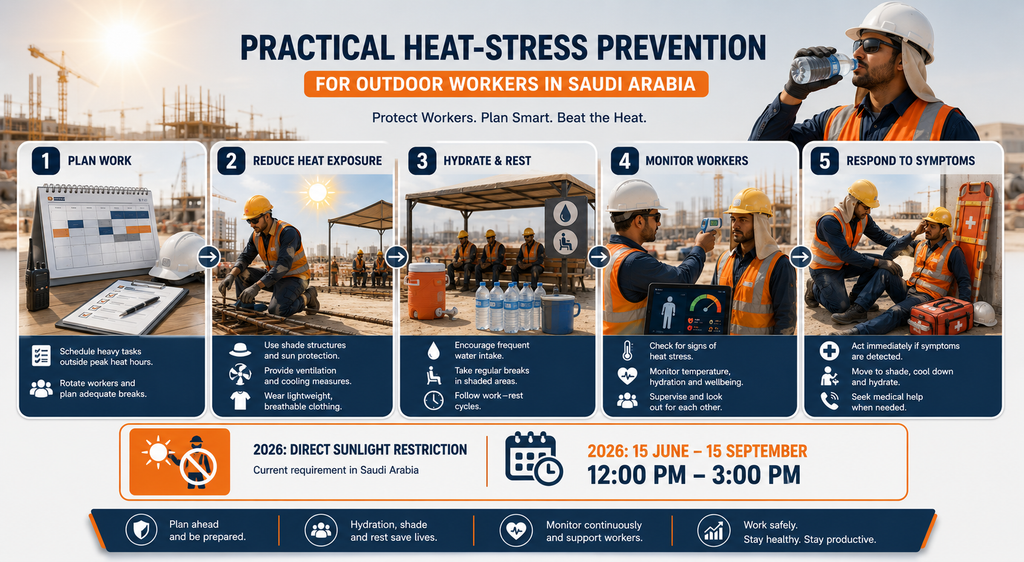
2026 Midday Work Ban
For 2026, the decision prohibiting work under direct sunlight applies from:
15 June 2026 to 15 September 2026
during the hours:
12:00 PM to 3:00 PM
The restriction applies to private-sector establishments and is intended to protect workers from direct exposure to the sun during the hottest part of the day.
Employers should organize work schedules accordingly and ensure that affected outdoor activities are planned to comply with the applicable decision.
Important: These dates are specifically for the 2026 season. They should not be presented as permanent dates for future years.
Employer Responsibilities
HRSD’s 2026 announcement emphasizes that employers have responsibilities related to preventing heat-stress risks.
Employers are expected to support worker protection by:
- Raising workers’ awareness of heat-stress risks and prevention.
- Monitoring workers’ physical condition during periods of high temperature.
- Ensuring workplace readiness for heat-related risks.
- Supporting the role of occupational safety and health personnel in monitoring compliance.
- Applying appropriate workplace inspection procedures and preventive measures before field activities begin.
Organizations should also follow the applicable official procedural and advisory guidance issued by Saudi authorities.
Practical Heat-Stress Controls
The official Saudi guidance provides information intended to help employers and workers prevent the effects of heat exposure and working in hot environments. NCOSH currently provides both a Procedural Guide for Preventing the Effects of Exposure to Direct Sun and Heat Stress and a Guidance Manual for Preventing the Effects of Working in Hot Environments.
In practical HSE management, employers should consider controls such as:
- Scheduling outdoor work to reduce heat exposure.
- Providing suitable shaded or cooled rest areas.
- Making drinking water readily available.
- Increasing worker awareness of heat-stress symptoms and prevention.
- Monitoring workers during high-temperature conditions.
- Considering workload, work duration, clothing and environmental conditions.
- Providing appropriate emergency arrangements.
- Supervising workers performing strenuous outdoor activities.
The exact control measures should be determined according to the workplace, activity, environmental conditions and applicable official guidance.
Recognizing Heat Stress
Heat stress can occur when the body is exposed to hot and humid conditions and cannot adequately control its temperature. The official Saudi procedural guidance identifies heat stress as a consequence of exposure to hot and humid weather and associated fluid loss.
HSE personnel and supervisors should ensure workers understand the importance of reporting symptoms or feeling unwell rather than continuing work when heat-related illness may be developing.
Any suspected serious heat-related illness should be treated as a medical emergency and managed according to the organization’s emergency arrangements and competent medical advice.
Practical HSE Compliance Approach
A practical approach to managing Saudi heat stress prevention requirements is:
Plan → Protect → Monitor → Respond → Review
1. Plan
Review weather conditions, work schedules, workforce requirements and heat-related hazards before starting outdoor activities.
2. Protect
Implement the applicable work restrictions and appropriate heat-exposure controls.
3. Monitor
Supervisors and HSE personnel should monitor working conditions and workers’ physical condition during periods of high heat.
4. Respond
Ensure workers know how to report symptoms and that appropriate emergency arrangements are available.
5. Review
Use inspections, observations and incidents to identify improvements to the heat-stress prevention program.
2026 Heat-Stress Compliance Checklist
- 2026 midday direct-sunlight restriction has been communicated.
- Outdoor work schedules comply with the applicable restriction.
- Workers have received heat-stress awareness information.
- Drinking water is readily available.
- Suitable shaded/rest arrangements are provided.
- Workers are monitored during high-temperature periods.
- Supervisors understand heat-stress prevention responsibilities.
- Emergency arrangements address heat-related illness.
- Workplace inspections consider heat exposure.
- Current Saudi official guidance is periodically reviewed.
Note: This is an original TheHSEVerse practical checklist. It is not an official Saudi government checklist.
Related HSE Resources
For practical implementation, readers can also use relevant TheHSEVerse resources such as:
- HSE Observation Report Form
- Construction Site Risk Assessment
- Construction Site Safety Inspection Checklist
Official References For Heat Stress
HRSD — 2026 Midday Work Ban Decision
Official HRSD 2026 announcement
NCOSH — Rules, Regulations and Guidance
Official NCOSH Rules & Regulations Library
NCOSH — Procedural Guide for Preventing the Effects of Direct Sun and Heat Stress
Official NCOSH Heat-Stress Procedural Guide
Last Reviewed
August 2026
This resource was reviewed against current official Saudi information available for the 2026 heat-stress season.
Disclaimer
This TheHSEVerse resource is an independent educational and practical guide. It is not an official Saudi regulation and does not replace current HRSD, NCOSH or other applicable Saudi government requirements.
Seasonal decisions and requirements may be updated. Always verify the latest official announcement before relying on specific dates, restrictions or compliance requirements.