
ISO 14001:2026 is the current international standard for environmental management systems (EMS). It provides organizations with a structured framework for managing environmental responsibilities, improving environmental performance, meeting applicable compliance obligations, and achieving environmental objectives.
The standard can be applied by organizations of different sizes and sectors. It covers environmental aspects that an organization determines it can control or influence, considering a life-cycle perspective.
ISO 14001:2026 at a Glance
| Item | Details |
|---|---|
| Standard | ISO 14001:2026 |
| Edition | 4th edition |
| Published | April 2026 |
| Status | Current and published |
| Issuing organization | International Organization for Standardization (ISO) |
| Subject | Environmental Management Systems |
| Previous edition | ISO 14001:2015 — withdrawn |
ISO confirms that ISO 14001:2026 replaced ISO 14001:2015. The new edition retains the established EMS framework while providing clearer structure and stronger alignment with current environmental priorities.
What Is an Environmental Management System?
An Environmental Management System provides a systematic way for an organization to manage its environmental responsibilities.
ISO 14001:2026 is designed to help organizations:
- Improve environmental performance
- Meet applicable compliance obligations
- Achieve environmental objectives
- Manage environmental risks and opportunities
- Improve resource efficiency
- Address environmental impacts systematically
The standard does not establish one specific environmental performance level that every organization must achieve. Instead, it provides the management-system framework for organizations to determine and improve their environmental performance according to their circumstances.
Key Areas of ISO 14001:2026
Environmental Aspects and Impacts
Organizations need to understand the environmental aspects associated with their activities, products and services and determine the environmental impacts that are relevant to their operations.
Examples may include:
- Waste generation
- Energy consumption
- Water use
- Emissions
- Chemical releases
- Resource consumption
- Pollution risks
- Biodiversity-related impacts
The organization determines which environmental aspects it can control or influence within its management-system scope.
Compliance Obligations
An effective EMS should consider applicable environmental legal requirements and other obligations relevant to the organization.
For an organization operating in Saudi Arabia, this may involve identifying applicable environmental requirements, permits, regulatory conditions and authority requirements relevant to its activities.
Important: ISO 14001 does not replace environmental legislation. Organizations must separately identify and comply with applicable legal and regulatory requirements.
Environmental Objectives
Organizations establish environmental objectives appropriate to their circumstances and environmental priorities.
Objectives can address areas such as:
- Waste reduction
- Resource efficiency
- Energy use
- Water consumption
- Pollution prevention
- Environmental performance improvement
Objectives should be supported by appropriate planning, responsibilities, monitoring and evaluation.
Climate Change, Biodiversity and Resource Efficiency
ISO 14001:2026 places stronger emphasis on today’s environmental priorities, including climate change, biodiversity and resource efficiency. ISO explains that the updated edition broadens consideration of environmental conditions such as pollution, resource availability, climate change, biodiversity and ecosystem health.
For organizations, this means environmental considerations can be more closely connected with business decisions, operational risks and opportunities.
The relevance of these issues should be determined according to the organization’s context and activities rather than assuming that every environmental issue has the same significance for every organization.
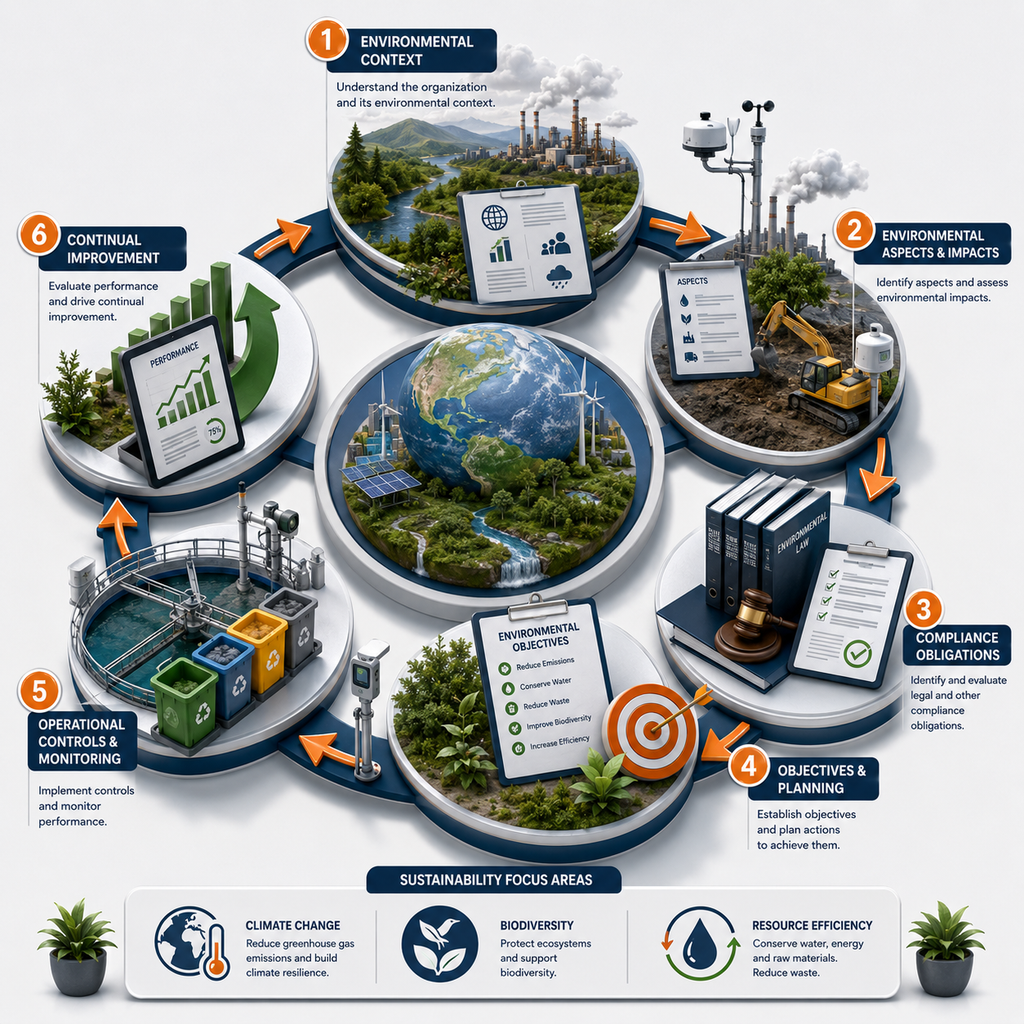
Operational Controls and Monitoring
An EMS should influence how environmental risks are managed during actual operations.
For construction and industrial organizations, practical controls may include:
- Waste segregation and disposal
- Spill prevention
- Chemical storage
- Dust and emission control
- Water management
- Energy management
- Pollution prevention
- Environmental inspections
- Contractor environmental controls
Organizations should monitor relevant environmental performance and use findings to identify problems, corrective actions and opportunities for improvement.
ISO 14001 and HSE/QHSE
ISO 14001 can complement occupational health and safety management systems such as ISO 45001.
Together, environmental and occupational safety management systems can support a broader QHSE management approach.
For example:
ISO 45001 → Occupational Health & Safety
ISO 14001 → Environmental Management
An integrated approach can help organizations coordinate responsibilities, audits, documentation, objectives and continual improvement across management systems.
ISO specifically describes ISO 14001:2026 as being designed for seamless integration with other ISO management-system standards, including ISO 45001.
Transition from ISO 14001:2015
ISO 14001:2015 is now withdrawn and has been replaced by ISO 14001:2026.
Organizations certified to ISO 14001:2015 should consult their certification body regarding transition arrangements rather than relying on unofficial transition dates or interpretations. ISO advises certified organizations to consult their certification body regarding the transition.
TheHSEVerse should therefore refer to ISO 14001:2026 as the current edition in new resources.
Practical EMS Implementation
A practical approach to implementing ISO 14001:2026 can include:
- Understand the organization’s environmental context.
- Identify relevant environmental aspects and impacts.
- Determine applicable compliance obligations.
- Identify environmental risks and opportunities.
- Establish environmental objectives.
- Implement appropriate operational controls.
- Monitor environmental performance.
- Investigate environmental nonconformities.
- Implement corrective actions.
- Review performance and continually improve the EMS.
These are TheHSEVerse practical implementation recommendations, not a substitute for the official ISO standard.
Quick Environmental Management Checklist
- Environmental aspects have been identified.
- Significant environmental issues are evaluated.
- Applicable environmental obligations are identified.
- Environmental objectives are established.
- Waste and pollution controls are implemented.
- Resource use is monitored where relevant.
- Environmental performance is evaluated.
- Environmental incidents and nonconformities are addressed.
- Corrective actions are tracked.
- Continual improvement opportunities are identified.
Note: This is an original TheHSEVerse practical checklist and is not an official ISO 14001 checklist.
Related HSE Resources
For practical implementation, connect this guide with relevant published TheHSEVerse resources, such as:
- HSE Observation Report Form
- Construction Site Risk Assessment
- Construction Site Safety Inspection Checklist
Official ISO References
ISO 14001:2026 — Environmental Management Systems
Official ISO 14001:2026 page
ISO — ISO 14001:2026 Published
ISO 14001:2026 publication announcement
ISO — What Changed in ISO 14001:2026
ISO 14001:2026 changes and business guidance
Last Reviewed
August 2026
This resource was reviewed against current official ISO information regarding ISO 14001:2026 and its replacement of ISO 14001:2015.
Disclaimer
This is an independent educational and practical guide prepared by TheHSEVerse. It is not the ISO 14001 standard and is not affiliated with or endorsed by the International Organization for Standardization.
Organizations should consult the current official ISO publication and applicable environmental laws, regulations, permits, contractual requirements and certification arrangements when making specific compliance decisions.