
The Lifting Operations Safety Checklist is a practical inspection tool designed to help HSE professionals, site supervisors, competent persons, consultants, and contractors verify essential safety controls before and during lifting operations.
Lifting activities involve hazards such as dropped loads, equipment failure, suspended loads, unstable ground, improper rigging, poor communication, and contact with overhead hazards.
This checklist provides 30 practical inspection points to help verify key lifting-operation controls and document findings requiring corrective action.
What Does This Lifting Operations Checklist Cover?
The checklist focuses on important areas including:
- Lifting planning and risk assessment
- Load weight and center of gravity
- Crane and lifting equipment suitability
- Ground conditions and crane stability
- Operator and lifting-team competency
- Lifting accessories
- Slings, shackles and hooks
- Safe load attachment
- Tag lines and load control
- Communication and signaling
- Exclusion zones
- Suspended-load controls
- Overhead power lines and obstructions
- Weather conditions
- Crane safety devices
- Equipment condition
- Lifting-path controls
- Emergency arrangements
- Inspection and corrective actions
Why Is Lifting Safety Important?
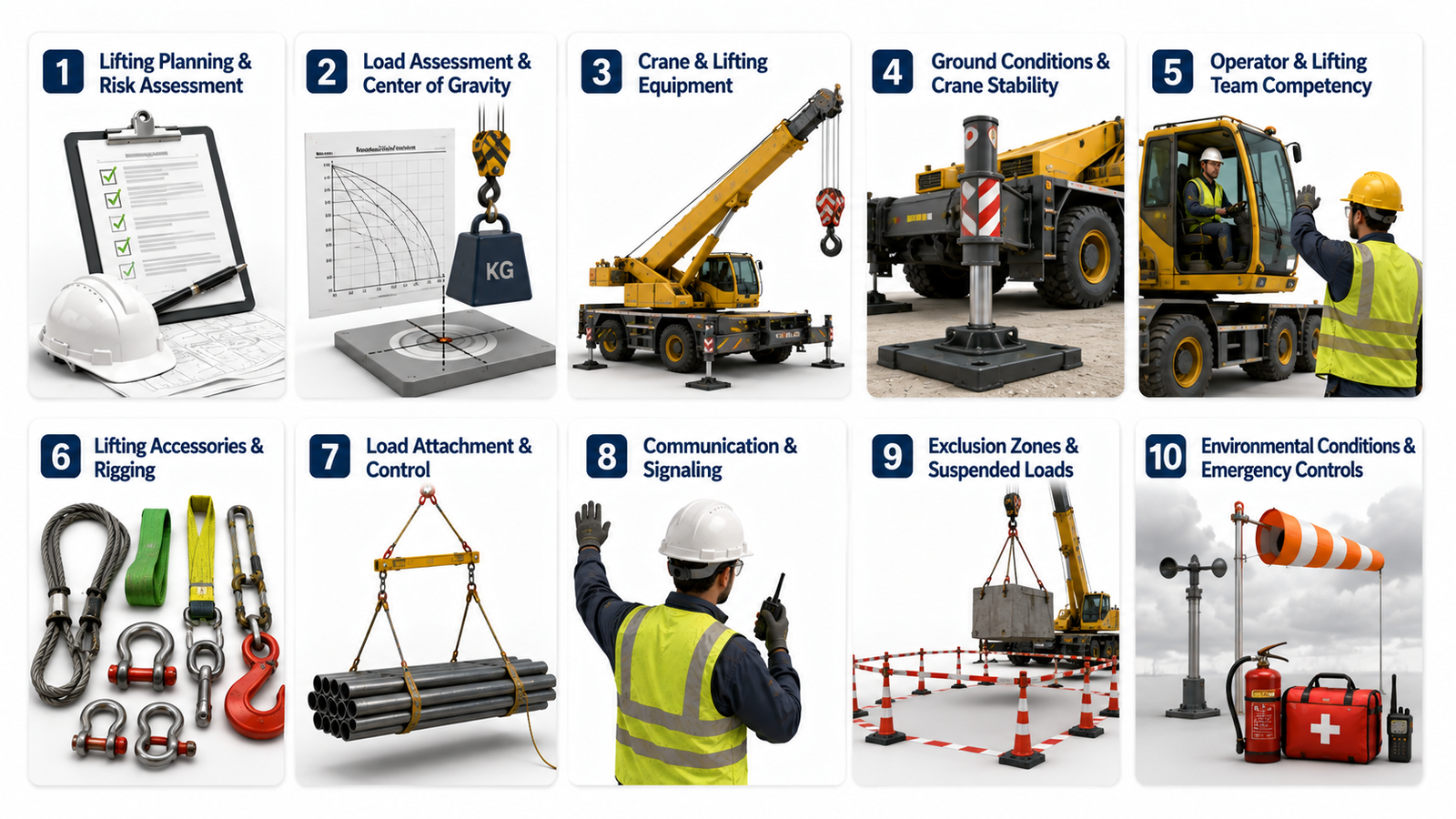
Lifting operations can involve significant risks when loads, equipment, lifting accessories, ground conditions, or communication systems are not properly controlled.
A safe lifting operation starts with proper planning and selection of suitable equipment and accessories. The load should be properly assessed, attached and controlled, while operators, riggers and signalers should be competent for their assigned duties.
The lifting area should also be controlled to prevent unauthorized personnel from entering the lifting zone or standing beneath suspended loads.
Regular inspection of cranes, lifting accessories and associated equipment helps identify defects before they contribute to an incident.
What Is Included in the Checklist?
The downloadable checklist contains 30 inspection points using a simple field-friendly format:
- Yes / No / N/A
- Remarks / Corrective Action
- Findings and observations
- Risk level
- Responsible person
- Target completion date
- Close-out status
- Overall assessment
- Inspector sign-off
- Supervisor / Responsible Person sign-off
The checklist is designed to help identify unsafe lifting conditions and document the corrective actions required.
When Should You Use It?
The checklist can be used during:
- Crane lifting operations
- Mobile crane inspections
- Material lifting activities
- Pre-lift inspections
- Routine lifting-operation inspections
- Rigging activities
- Lifting accessory inspections
- Contractor lifting inspections
- Critical or complex lifting operations
- Corrective-action verification
How to Use the Lifting Operations Checklist
1. Review the Lifting Plan
Confirm that the lifting operation has been properly planned and that the required risk assessment, lifting plan, method statement and permits are available where required.
2. Verify Equipment Suitability
Check that the crane or lifting equipment has adequate capacity for the planned load, lifting radius and operating conditions.
3. Inspect Lifting Accessories
Check slings, shackles, hooks, spreader beams and other lifting accessories for suitability, identification, inspection status and visible damage.
4. Check Ground and Setup Conditions
Verify that the crane is positioned on suitable ground and that outriggers, stabilizers and other supporting systems are correctly deployed where required.
5. Control the Lifting Area
Ensure the lifting zone is properly controlled and that workers and unauthorized personnel remain clear of suspended loads and the lifting path.
6. Verify Communication
Confirm that the operator, signaler and lifting team have an effective communication system and understand the agreed signals.
7. Monitor Environmental Conditions
Check wind, rain, lightning, visibility and other environmental conditions that could affect the safety of the lifting operation.
8. Record Findings
Mark each inspection item as Yes, No or N/A and record clear remarks for any deficiency.
9. Assign Corrective Actions
Record significant findings with a risk level, corrective action, responsible person, target date and close-out status.
Download the Lifting Operations Safety Checklist
Download the complete 30-point Lifting Operations Safety Checklist for practical construction site inspections.
Related HSE Resources
Continue building your lifting safety system with related TheHSEVerse resources:
→ Construction Site Safety Inspection Checklist
→ Work at Height Safety Checklist
→ Excavation & Trenching Safety Checklist
External Guidance
External Guidance
For additional guidance on lifting operations and crane safety:
Important Safety Disclaimer
This checklist is provided as a practical safety inspection aid. It does not replace applicable legislation, regulatory requirements, project-specific HSE requirements, lifting plans, risk assessments, method statements, approved procedures, manufacturer instructions, or competent professional judgment.
Users should adapt the checklist to the specific project, lifting equipment, load characteristics, activities, hazards, contractual requirements, and applicable legal and regulatory requirements.
Always verify applicable local legal and regulatory requirements before using this checklist as part of a formal compliance inspection.