
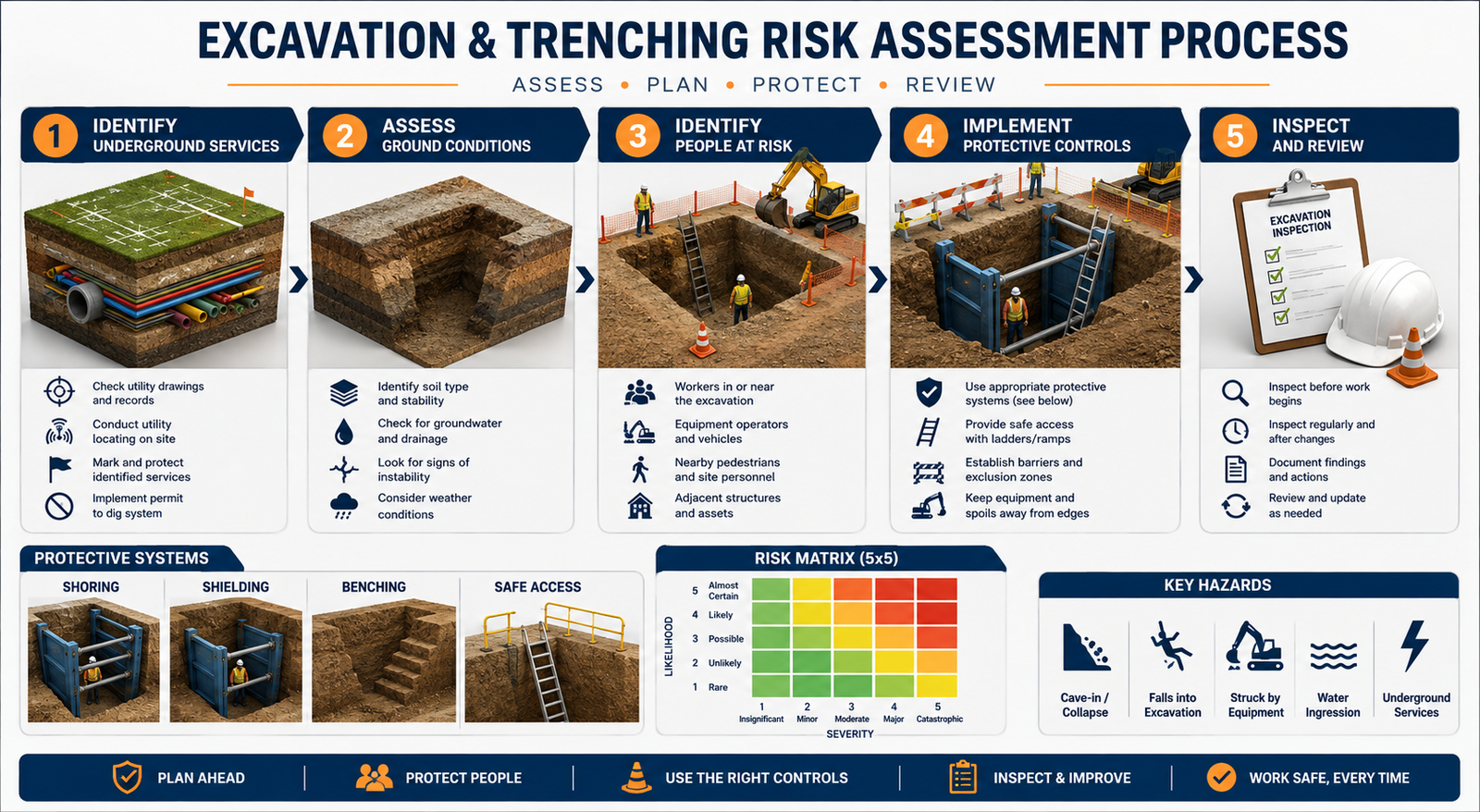
Excavation and trenching activities can expose workers to serious hazards, including ground collapse, falling materials, underground services, hazardous atmospheres, plant movement, water accumulation and falls into excavations. Proper planning, competent supervision and effective protective systems are essential before workers enter or work around an excavation.
This Excavation Risk Assessment provides a practical reference for identifying common excavation hazards, evaluating risks and establishing suitable control measures for construction and civil works.
The completed assessment can be adapted to suit specific project conditions, excavation depths, soil conditions, equipment, work methods and site requirements.
What Does This Excavation Risk Assessment Cover?
The assessment addresses common excavation and trenching hazards, including:
- Excavation and trench collapse
- Unstable or unsuitable ground conditions
- Underground electrical and utility services
- Excavation edge collapse
- Falling materials and spoil
- Mobile plant operating near excavation edges
- Workers falling into excavations
- Unsafe access and egress
- Water accumulation and flooding
- Hazardous atmospheres
- Oxygen deficiency
- Excavation near existing structures
- Adjacent excavation and surcharge loading
- Poor excavation barricading
- Night work and inadequate lighting
- Excavation near roads and traffic routes
- Mechanical excavation
- Manual excavation
- Shoring and protective systems
- Excavation inspection requirements
- Adverse weather conditions
- Plant and equipment interaction
- Material storage near excavation edges
- Simultaneous operations
- Emergency rescue from excavations
The assessment considers both the hazards affecting workers inside excavations and those affecting personnel working or moving around excavation areas.
What Is Included?
The full risk assessment document includes:
- Document and assessment information
- Purpose and scope
- Persons at risk
- Excavation and trenching control principles
- Activities and equipment covered
- Risk assessment methodology
- 5 × 5 risk matrix
- Detailed excavation and trenching hazards
- Existing control measures
- Further control measures
- Initial risk ratings
- Residual risk ratings
- Responsible persons
- Inspection and monitoring requirements
- Review triggers
- Emergency and rescue arrangements
- Roles and responsibilities
- Worker acknowledgement
- Review and approval section
- Professional disclaimer
The assessment emphasizes the importance of determining ground conditions, identifying underground services, providing suitable protective systems and maintaining safe access before workers enter an excavation.
How to Use This Risk Assessment
Before excavation begins, the assessment should be reviewed by a competent person against the actual site conditions and proposed work method.
The assessment should consider excavation depth and dimensions, soil and ground conditions, nearby structures, underground services, groundwater, weather conditions, plant movement, adjacent traffic, spoil placement and access requirements.
Where required, suitable protective measures such as sloping, benching, shoring or other engineered protective systems should be provided. Excavation edges should also be protected against falls, and spoil, materials and mobile plant should be positioned so they do not create additional loading or collapse hazards.
A permit-to-dig or similar control process should be used where required by the project. Underground services should be identified, located and clearly marked before mechanical excavation begins.
Workers entering excavations should receive appropriate training and briefing, and excavation inspections should be carried out by competent personnel before entry and following events that could affect stability.
When Should the Risk Assessment Be Reviewed?
An excavation risk assessment should be treated as a live document throughout the excavation activity.
It should be reviewed when excavation depth or dimensions change, ground conditions deteriorate, groundwater appears, heavy rain occurs, nearby structures or services are affected, plant locations change, protective systems are modified, or additional workers and contractors become involved.
The assessment should also be reviewed following an incident, near miss, ground movement, collapse, unexpected service discovery or other significant change in conditions.
Regular inspections help confirm that excavation protection, access, barricading, spoil placement, water control and surrounding conditions remain safe.
Who Can Use This Resource?
This resource can support:
- HSE Managers and HSE Engineers
- Safety Officers and Supervisors
- Construction Managers
- Civil Engineers
- Site Engineers
- Excavation Supervisors
- Project Managers
- Contractors and subcontractors
- HSE consultants
- Students and HSE professionals
It can also support the preparation of task-specific risk assessments, excavation permits, JSA/JHA documents, method statements and excavation safety plans.
Download the Full Risk Assessment
The complete Excavation Risk Assessment is available as an editable DOCX document containing detailed hazards, risk ratings, control measures, responsibilities, inspection requirements and emergency arrangements.
Related Resources
External Guidance
Disclaimer
This excavation risk assessment is provided as a general HSE reference. It does not replace a project-specific risk assessment, method statement, excavation design, permit, or competent-person review. Always adapt it to actual site conditions, applicable requirements, and project-specific hazards before use.