
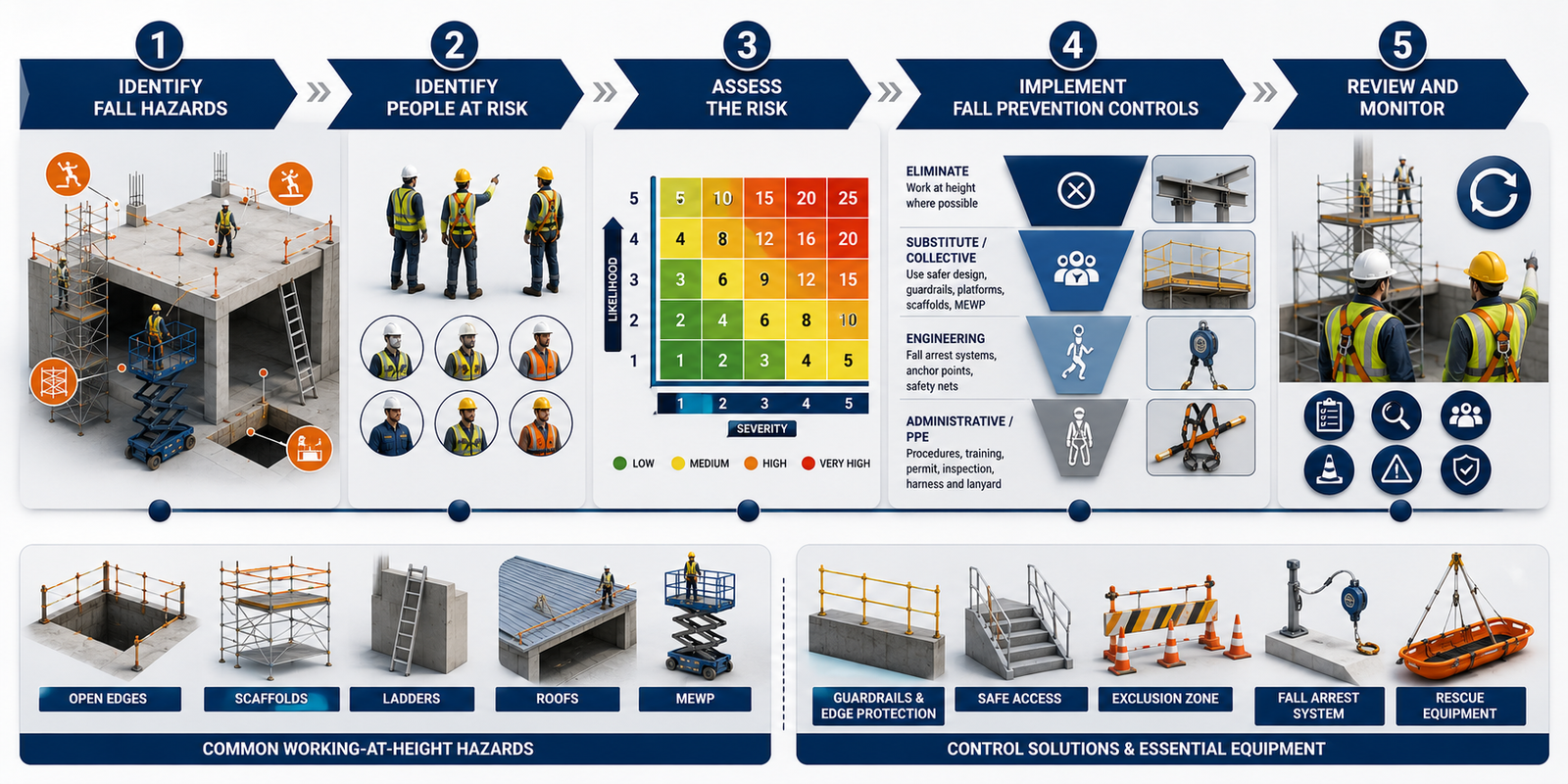
Working at height is one of the most significant hazards in construction, with falls from ladders, scaffolds, roofs, platforms, openings and elevated work areas capable of causing serious injury or fatality. Effective work-at-height management starts with proper planning, competent personnel, suitable access equipment and effective fall-prevention measures.
This Working at Height Risk Assessment provides a practical reference for identifying common fall hazards, evaluating risk and establishing appropriate control measures before and during work at height.
The completed assessment is designed for construction and related work environments and can be adapted to suit specific projects, activities, equipment and site conditions.
What Does This Working at Height Risk Assessment Cover?
The assessment addresses common working-at-height hazards and activities, including:
- Falls from open edges
- Unprotected floor and wall openings
- Scaffold work
- Ladder use
- Roof work
- Fragile surfaces
- Temporary working platforms
- Mobile elevating work platforms
- Fall-arrest and fall-restraint systems
- Unsafe access and egress
- Falling objects and dropped tools
- Work near excavations and lower levels
- Formwork and reinforcement activities
- Poor housekeeping at elevated locations
- Adverse weather conditions
- Electrical hazards near elevated work
- Simultaneous operations
- Inadequate inspection of access equipment
- Improper use of personal fall-protection equipment
- Emergency and fall-rescue arrangements
The assessment considers both fall prevention and measures intended to minimize the consequences of a fall where prevention alone cannot completely eliminate the risk.
What Is Included?
The full risk assessment document includes:
- Document and assessment information
- Purpose and scope
- Persons at risk
- Working-at-height control principles
- Activities and equipment covered
- Risk assessment methodology
- 5 × 5 risk matrix
- Detailed working-at-height hazards
- Existing control measures
- Further control measures
- Initial risk ratings
- Residual risk ratings
- Responsible persons
- Inspection and monitoring requirements
- Review triggers
- Emergency and rescue arrangements
- Roles and responsibilities
- Worker acknowledgement
- Review and approval section
- Professional disclaimer
The assessment follows the general principle of considering whether work at height can be avoided, and where it cannot, selecting suitable equipment and controls to prevent falls or reduce the distance and consequences of a fall. This approach is consistent with established HSE guidance.
How to Use This Risk Assessment
Before using the assessment on an actual project, a competent person should review the work activity and confirm that the listed hazards and controls reflect the real working environment.
The assessment should consider the height and location of the task, duration and frequency of the work, condition of the working surface, access requirements, weather, equipment selection, nearby activities and the potential consequences of a fall.
Where practical, collective protection such as permanent or temporary guardrails, protected platforms and suitable access systems should be considered before relying on individual fall-protection equipment.
Where personal fall-protection systems are required, workers should be trained and the equipment should be suitable, inspected and correctly used. A suitable rescue arrangement should also be established because simply providing a harness does not by itself constitute a complete fall-protection system. OSHA guidance similarly emphasizes planning, suitable equipment and worker training for fall prevention.
When Should the Risk Assessment Be Reviewed?
A working-at-height risk assessment should be treated as a live document and reviewed whenever conditions or work methods change.
Review should take place before work starts and whenever there is a change to access equipment, scaffold configuration, roof conditions, work location, weather, personnel, nearby activities or the fall-protection system.
It should also be reviewed following an incident, near miss, equipment failure, unsafe observation or identification of a new fall hazard.
Regular inspections are particularly important for scaffolds, ladders, platforms, MEWPs, guardrails, anchor points and personal fall-protection equipment. Defective equipment should be removed from service until it has been assessed and made safe. OSHA and HSE guidance both emphasize appropriate equipment selection, inspection, maintenance and competent use.
Who Can Use This Resource?
This resource can support:
- HSE Managers and HSE Engineers
- Safety Officers and Supervisors
- Construction Managers
- Site Engineers
- Project Managers
- Scaffolding Supervisors
- Construction contractors and subcontractors
- HSE consultants
- Students and HSE professionals
It can also be used as a reference when developing task-specific risk assessments, JSA/JHA documents, method statements and fall-protection plans.
Download the Full Risk Assessment
The complete Working at Height Risk Assessment is available as an editable DOCX document containing the detailed hazards, risk ratings, control measures, responsibilities, inspection requirements and emergency arrangements.
Related HSEVerse Resources
External Guidance
- HSE – Introduction to Working at Height Safely
- HSE – Working at Height: A Brief Guide
- OSHA – Fall Protection Standards
Disclaimer
This Working at Height Risk Assessment is provided as a general HSE reference resource and does not replace a project-specific risk assessment, method statement, JSA/JHA, permit, fall-protection plan, rescue plan, engineering assessment or competent-person review.
Users should adapt the assessment to the actual work environment, height and duration of the task, access arrangements, equipment, site conditions, weather, workforce competency, applicable legislation, client requirements and manufacturer instructions.