
Lifting operations are a critical part of many construction projects and can expose workers to serious hazards when lifting equipment, loads, ground conditions, rigging arrangements, or communication are not properly controlled. Dropped loads, crane overturning, struck-by incidents, suspended loads and defective lifting accessories can result in severe injuries, fatalities, equipment damage and significant project disruption.
This Lifting Operation Risk Assessment provides a practical reference for identifying common hazards associated with lifting activities, evaluating the level of risk and establishing appropriate control measures before and during lifting operations.
The completed assessment can be adapted to suit different construction projects, lifting equipment, load types, site conditions and lifting methods.
What Does This Risk Assessment Cover?
The assessment addresses common lifting-operation hazards, including:
- Crane setup and positioning
- Ground stability and outrigger support
- Overloading and incorrect load calculations
- Suspended and falling loads
- Defective lifting accessories
- Incorrect slinging and rigging
- Unbalanced or unstable loads
- Crane movement and overturning
- Poor communication between lifting team members
- Blind lifts
- Inadequate exclusion zones
- Personnel working beneath suspended loads
- Load swing and uncontrolled movement
- Lifting near structures and overhead obstructions
- Lifting near electrical lines
- Mobile crane and mobile plant interfaces
- Manual handling during rigging
- Weather and high winds
- Poor visibility and lighting
- Unauthorized crane operation
- Inadequate equipment inspection
- Lifting personnel
- Delivery and unloading operations
- Simultaneous construction activities
- Emergency and dropped-load response
The lifting operation risk assessment considers hazards affecting crane operators, riggers, banksmen, lifting supervisors, workers within the lifting area, and other personnel who may be exposed to the operation.
What Is Included?
The full risk assessment document includes:
- Document and assessment information
- Purpose and scope
- Persons at risk
- Lifting-operation control principles
- Activities and equipment covered
- Risk assessment methodology
- 5 × 5 risk matrix
- Detailed lifting-operation hazards
- Existing control measures
- Further control measures
- Initial risk ratings
- Residual risk ratings
- Responsible persons
- Inspection and monitoring requirements
- Review triggers
- Emergency and rescue arrangements
- Roles and responsibilities
- Worker acknowledgement
- Review and approval section
- Professional disclaimer
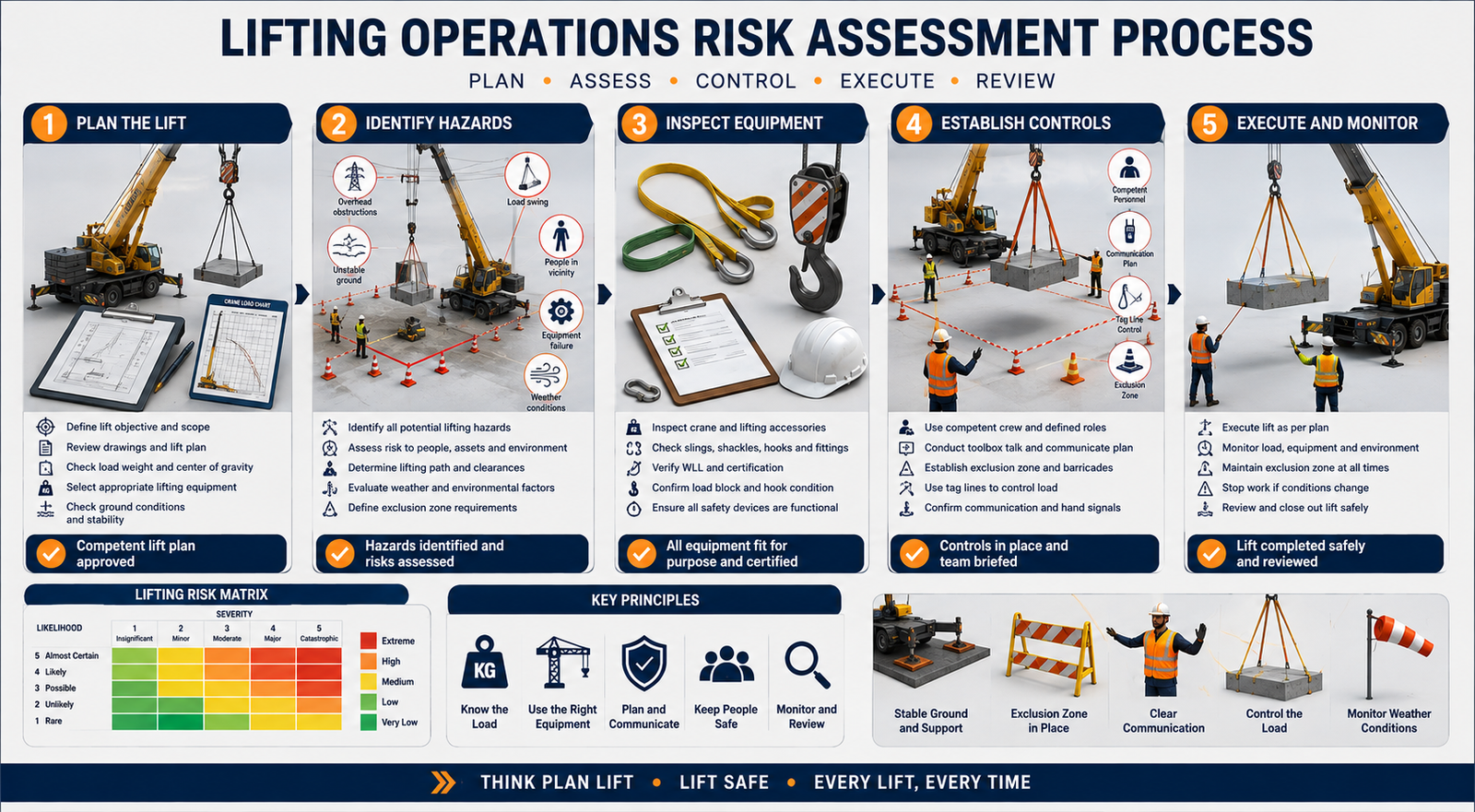
The assessment emphasizes proper lifting planning, suitable equipment selection, competent personnel, inspected lifting accessories, load control, communication and exclusion zones.
How to Use This Risk Assessment
Before a lifting operation begins, the assessment should be reviewed by a competent person and considered alongside the lifting plan, method statement and equipment requirements.
The lifting activity should be planned according to the load weight, dimensions, center of gravity, lifting points, lifting radius, equipment capacity, ground conditions and intended travel path. The crane or lifting equipment must be suitable for the planned operation and operated within its rated capacity.
Lifting accessories such as slings, shackles, hooks and spreader beams should be suitable for the load, inspected before use and correctly connected. Defective or unidentified accessories should be removed from service.
A suitable exclusion zone should be established around the lifting area to prevent unauthorized personnel from entering areas exposed to suspended or moving loads. Workers should never position themselves beneath a suspended load.
Clear communication between the operator, lifting supervisor, riggers and banksman is essential. Where visibility is restricted, appropriate communication systems and agreed signals should be established before the lift begins.
When Should the Risk Assessment Be Reviewed?
The lifting operation risk assessment should be treated as a live document and reviewed whenever the lifting conditions or operation change.
It should be reassessed when the crane or lifting equipment changes, the load changes, the lifting radius changes, the work location changes, ground conditions deteriorate, weather conditions become unsuitable, or the lifting method is modified.
The assessment should also be reviewed following an incident, near miss, dropped load, equipment failure, lifting-accessory defect or significant change in the work environment.
Regular inspections should confirm that lifting equipment, accessories, exclusion zones, communication systems and supporting controls remain suitable throughout the operation.
Who Can Use This Resource?
This resource can support:
- HSE Managers and HSE Engineers
- Safety Officers and Supervisors
- Lifting Supervisors
- Appointed Persons
- Crane Operators
- Riggers and Banksmen
- Construction Managers
- Site Engineers
- Project Managers
- Contractors and subcontractors
- HSE consultants
- Students and HSE professionals
It can also support the preparation of lifting plans, task-specific risk assessments, JSA/JHA documents, method statements and lifting-operation briefings.
Download the Full Risk Assessment
The complete Lifting Operation Risk Assessment is available as an editable DOCX document containing detailed hazards, risk ratings, control measures, responsibilities, inspection requirements and emergency arrangements.
Related HSEVerse Resources
External Guidance
- HSE – LOLER: Lifting Operations and Lifting Equipment Regulations
- HSE – Lifting Equipment at Work
- OSHA – Cranes & Derricks in Construction
Disclaimer
This lifting operation risk assessment is provided as a general HSE reference. It does not replace a project-specific risk assessment, method statement, excavation design, permit, or competent-person review. Always adapt it to actual site conditions, applicable requirements, and project-specific hazards before use.