
ISO 45001:2018 is the international standard for occupational health and safety (OH&S) management systems. It provides organizations with a structured framework for managing workplace health and safety risks, preventing work-related injury and ill health, and continually improving OH&S performance.
The standard can be applied by organizations of different sizes, industries and geographical locations, including construction, manufacturing, energy, logistics and service organizations.
ISO 45001 should be understood as a management-system standard, not as a replacement for national safety laws, regulations or specific workplace requirements.
ISO 45001:2018 at a Glance
| Item | Details |
|---|---|
| Standard | ISO 45001:2018 |
| Official title | Occupational health and safety management systems — Requirements with guidance for use |
| Issuing organization | International Organization for Standardization (ISO) |
| Edition | First edition |
| Published | March 2018 |
| Current status | Published and current |
| Latest amendment | ISO 45001:2018/Amd 1:2024 |
| Amendment | Climate action changes |
| Current revision | ISO/DIS 45001 under development |
ISO confirms that ISO 45001:2018 was last reviewed and confirmed in 2024 and remains current. ISO also states that it is expected to be replaced by ISO/DIS 45001 in the coming months.
What Is ISO 45001?
ISO 45001 establishes requirements for an OH&S management system. Its framework helps organizations systematically identify hazards, assess and control OH&S risks, establish objectives, monitor performance and improve their safety management processes.
The standard emphasizes areas such as:
- Leadership and commitment
- Worker participation
- Hazard identification
- OH&S risk assessment
- Applicable legal and other requirements
- Operational controls
- Emergency preparedness
- Performance evaluation
- Incident and nonconformity management
- Continual improvement
The objective is to make occupational health and safety part of the organization’s management processes rather than treating safety as a separate activity handled only by the HSE department.
Key Areas of ISO 45001
1. Leadership and Worker Participation
Effective OH&S management requires leadership involvement and appropriate worker participation.
Management should support the OH&S system through appropriate resources, objectives, responsibilities and decision-making. Workers can contribute valuable information about hazards, operational problems and the effectiveness of controls.
2. Hazard Identification and Risk Assessment
Organizations need a systematic approach to identifying hazards and managing OH&S risks.
Depending on the workplace, hazards may include:
- Working at height
- Lifting operations
- Excavation
- Electrical work
- Mobile equipment
- Hazardous substances
- Confined spaces
- Traffic movements
- Heat exposure
- Ergonomic and psychosocial hazards
Risk assessment should lead to appropriate controls and should be reviewed when significant changes occur.
3. Legal and Other Requirements
ISO 45001 addresses the identification and management of applicable legal and other requirements.
For example, a company operating in Saudi Arabia should identify the Saudi laws, regulations and applicable authority requirements relevant to its activities.
Important: ISO 45001 does not replace national legislation. An organization must continue to identify and comply with applicable legal and regulatory requirements.
4. Operational Controls
The management system should influence how work is actually performed.
For a construction organization, this can include controls for:
- High-risk activities
- Contractors
- Lifting operations
- Work at height
- Excavation
- Electrical activities
- Plant and equipment
- Emergency arrangements
- Hazardous materials
- Traffic management
The exact controls should be determined according to the organization’s hazards, risks and applicable requirements.
5. Emergency Preparedness
Organizations should consider foreseeable emergency situations relevant to their activities.
Depending on the workplace, these may include fire, serious injury, chemical release, severe weather, equipment failure, heat-related emergencies or evacuation.
Emergency arrangements should be maintained, communicated and reviewed, with exercises or drills conducted where appropriate.
6. Performance Evaluation and Improvement
An effective OH&S management system should be monitored to determine whether it is working.
Organizations can use information such as:
- Incident trends
- Near misses
- Safety inspections
- Audit findings
- Corrective actions
- Training performance
- Safety observations
- Emergency exercises
- Other relevant OH&S indicators
Findings should be used to identify weaknesses, implement corrective actions and support continual improvement.
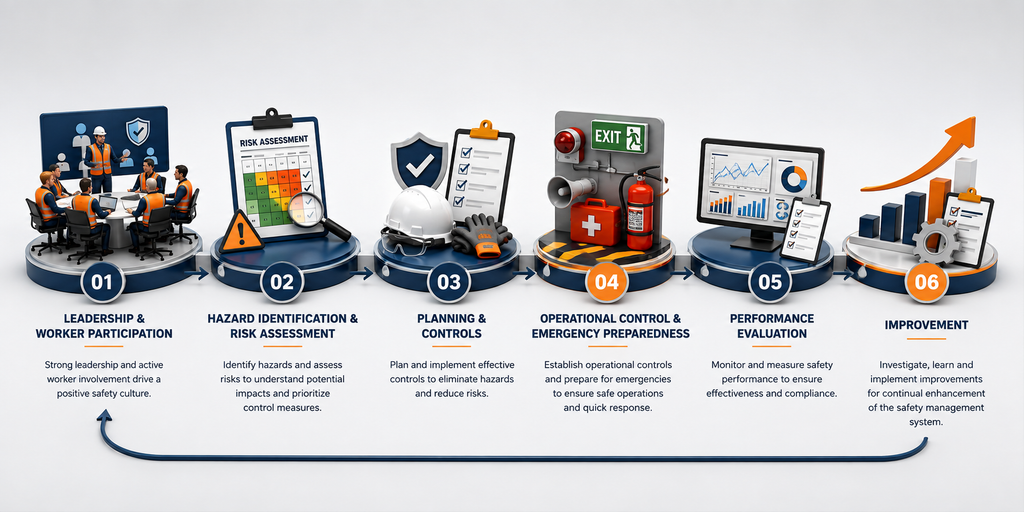
ISO 45001 and the Plan-Do-Check-Act Approach
ISO 45001 uses the Plan-Do-Check-Act (PDCA) methodology to support systematic management and continual improvement.
Plan: Identify hazards, assess risks, determine requirements and establish objectives.
Do: Implement controls, procedures, competence processes and operational arrangements.
Check: Monitor performance, investigate incidents, conduct inspections and audits, and evaluate results.
Act: Address nonconformities, implement corrective actions and improve the management system.
For HSE professionals, this approach helps connect planning activities with actual workplace performance.
ISO 45001 Certification
Organizations can implement ISO 45001 without necessarily pursuing certification.
Where certification is desired, an independent certification body evaluates the organization’s OH&S management system against the applicable requirements. ISO itself does not certify organizations.
Certification should also not be confused with legal compliance.
An organization may hold ISO 45001 certification while still needing to separately identify and comply with all applicable national laws, regulations and other obligations.
ISO 45001 and the 2024 Climate Action Amendment
ISO 45001:2018 has one published amendment:
ISO 45001:2018/Amd 1:2024 — Climate action changes.
The amendment was published in February 2024 and applies to ISO 45001:2018.
Organizations should therefore consider whether climate change is a relevant issue within their OH&S management-system context.
Depending on the workplace, climate-related factors may influence occupational risks such as:
- Extreme heat
- Severe weather
- Outdoor work conditions
- Emergency preparedness
- Worker exposure
- Operational disruption
The relevance and significance of these issues should be determined according to the organization’s circumstances and risk profile.
ISO 45001 Revision — Current Status in 2026
ISO is currently developing a revised edition of ISO 45001.
The official ISO record identifies ISO/DIS 45001 as the draft for the next edition. It remains under development and should not be treated as the current published standard.
As of this review:
Current published standard: ISO 45001:2018
Current revision: ISO/DIS 45001 — under development
Organizations should therefore avoid treating draft requirements as finalized requirements until the revised standard is officially published.
TheHSEVerse will update this resource when the official status changes.
Practical ISO 45001 Implementation Guide
For an HSE professional, practical implementation can begin with the following steps:
- Understand the organization’s activities and OH&S context.
- Identify workplace hazards.
- Assess OH&S risks and determine appropriate controls.
- Identify applicable legal and other requirements.
- Establish OH&S objectives and responsibilities.
- Implement operational controls.
- Support worker participation and appropriate competence.
- Prepare for foreseeable emergencies.
- Monitor OH&S performance.
- Investigate incidents and address nonconformities.
- Conduct appropriate audits and management reviews.
- Continually improve the OH&S management system.
These are TheHSEVerse practical implementation recommendations, not a replacement for the official ISO standard.
TheHSEVerse Practical Verification Checklist
Use this checklist as a quick management-system review aid:
- OH&S policy and objectives are established.
- Leadership responsibilities are defined.
- Workers have appropriate opportunities for participation.
- Workplace hazards are identified.
- OH&S risks are assessed.
- Appropriate risk controls are implemented.
- Applicable legal and other requirements are identified.
- Operational controls reflect identified risks.
- Emergency arrangements are established and reviewed.
- OH&S performance is monitored.
- Incidents and nonconformities are investigated.
- Corrective actions are tracked and verified.
- Internal audits are conducted where appropriate.
- Management reviews are performed as appropriate.
- Continual improvement opportunities are identified.
- Climate-change relevance is considered where applicable.
Note: This is an original TheHSEVerse practical checklist. It is not an official ISO checklist and does not replace ISO 45001 or certification-audit criteria.
Key Takeaways
ISO 45001:2018 provides an internationally recognized framework for managing occupational health and safety through a systematic management approach.
For HSE professionals, the most important concepts are:
- Identify hazards before they cause harm.
- Manage OH&S risks systematically.
- Involve workers in safety processes.
- Integrate safety into operational decision-making.
- Monitor performance rather than relying only on incident statistics.
- Investigate problems and use findings to improve controls.
- Maintain awareness of applicable legal requirements.
- Continually improve the OH&S management system.
ISO 45001:2018 remains the current published edition as of August 2026, while its replacement is under development.
Related HSE Resources
- Construction Site Risk Assessment → practical risk identification and control
- Work at Height Safety Checklist → workplace verification
- Construction Site Safety Inspection Checklist → monitoring and performance evaluation
Official References
ISO 45001:2018 — Occupational health and safety management systems
Official ISO 45001:2018 page
ISO 45001:2018/Amd 1:2024 — Climate action changes
Official ISO amendment page
ISO/DIS 45001 — Revision under development
Official ISO/DIS 45001 page
Last Reviewed
August 2026
This resource was reviewed against current official ISO information regarding ISO 45001:2018, its 2024 amendment and the status of the revision under development.
Disclaimer
This is an independent educational and practical guide prepared by TheHSEVerse. It is not the ISO 45001 standard and is not affiliated with or endorsed by the International Organization for Standardization (ISO).
Organizations should consult the current official ISO publication and applicable legal, regulatory, contractual and certification requirements when making specific compliance or certification decisions.