
Saudi environmental compliance requirements are an important part of managing construction, industrial and other activities that may have an environmental impact.
The National Center for Environmental Compliance (NCEC) is responsible for important aspects of environmental compliance in Saudi Arabia, including environmental permitting, licensing and inspection activities. NCEC states that environmental permits and licenses are used to oversee compliance with the Environment Law and its implementing regulations.
This guide provides a practical overview for HSE, environmental and project professionals. It does not replace the applicable Saudi environmental legislation, regulations, permits or official NCEC requirements.
What Is NCEC?
The National Center for Environmental Compliance (NCEC) is the Saudi authority responsible for environmental compliance activities within its regulatory framework.
Its official functions include environmental permitting and licensing, environmental inspection, review of self-inspection reports, monitoring compliance and following up on correction of environmental violations.
For organizations, this means environmental compliance should be considered during project planning, construction, operation and environmental monitoring, according to the activities and requirements applicable to the facility or project.
Environmental Permits and Compliance
NCEC oversees environmental permitting and licensing processes for facilities and activities subject to applicable environmental requirements. Its environmental permitting function includes supervising the issuance of environmental permits and licenses and monitoring compliance with the Environment Law and its implementing regulations.
Organizations should therefore determine:
- Whether their activity requires an environmental permit or license.
- Which environmental requirements apply to the activity.
- What conditions are attached to an applicable permit.
- What monitoring or reporting obligations apply.
- Whether environmental changes require further regulatory review.
Important: Permit requirements can vary according to the activity, facility classification and environmental impact. HSE professionals should verify the applicable requirements through the current official NCEC system rather than assuming that one permit arrangement applies to every project.
Environmental Inspection and Compliance
Environmental inspection is an important part of the NCEC compliance framework.
NCEC describes activities including planned and emergency inspections, review of self-inspection reports, issuing notifications for violations and following up on corrective actions.
For project teams, practical preparation should include maintaining:
- Environmental permits and approvals
- Environmental management plans
- Inspection and monitoring records
- Waste documentation
- Environmental incident records
- Corrective-action records
- Relevant monitoring reports
- Contractor environmental records
Documentation should be current, traceable and consistent with the applicable regulatory and permit requirements.
Construction Environmental Controls
Construction activities can create environmental impacts involving dust, waste, noise, wastewater, soil contamination, spills, emissions and resource use.
A practical construction environmental program may therefore include:
Dust and Air Quality
Control dust generated by construction activities, material handling, traffic and other applicable sources in accordance with project and regulatory requirements.
Waste Management
Segregate, store, transport and dispose of waste through appropriate arrangements and authorized channels where required.
Spill and Pollution Prevention
Control fuels, oils, chemicals and other materials that could contaminate soil or water.
Environmental Monitoring
Where monitoring is required, ensure appropriate measurements, records, equipment and competent personnel are used according to the applicable requirements.
NCEC provides specific licensing services for environmental monitoring activities covering environmental media such as air, water, soil and noise, as well as pollution sources.
Practical HSE Compliance Approach
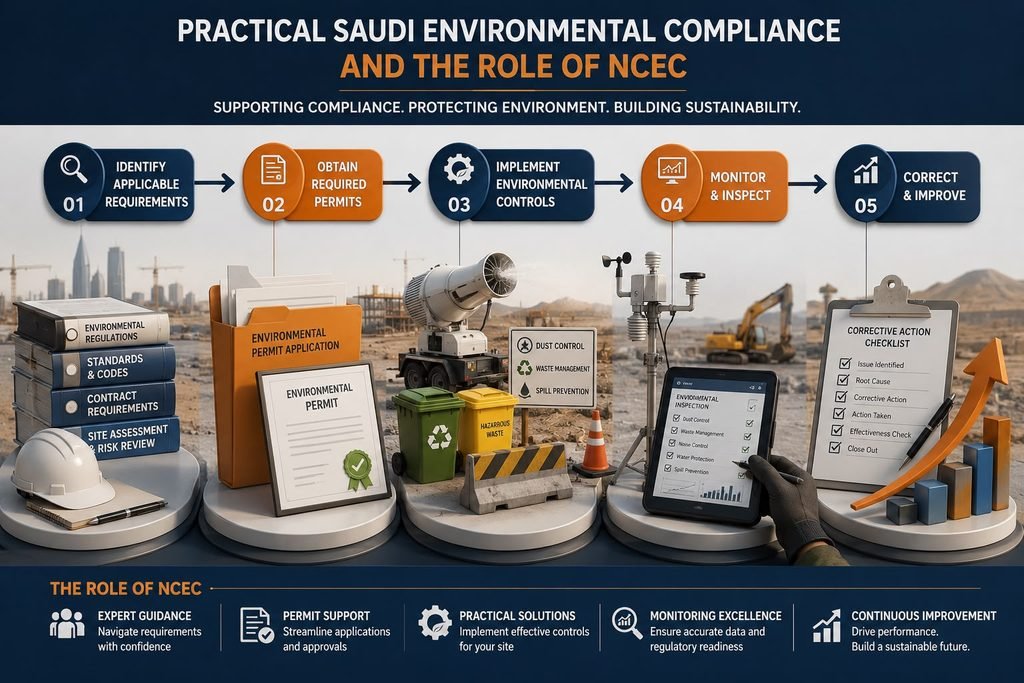
A practical approach to Saudi environmental compliance is:
Identify → Permit → Control → Monitor → Correct → Improve
Identify: Determine the environmental aspects and applicable regulatory requirements.
Permit: Confirm required environmental permits, licenses and approvals.
Control: Implement controls for waste, pollution, emissions, dust, spills and other relevant impacts.
Monitor: Conduct required inspections and environmental monitoring.
Correct: Record deficiencies, investigate environmental incidents and complete corrective actions.
Improve: Review environmental performance and strengthen controls where necessary.
These are practical HSE recommendations from TheHSEVerse and should not be interpreted as additional legal requirements.
Quick NCEC Compliance Checklist
- Applicable environmental requirements have been identified.
- Required environmental permits have been verified.
- Permit conditions are understood and implemented.
- Environmental risks and impacts have been assessed.
- Waste management arrangements are established.
- Dust and pollution controls are implemented.
- Spill-prevention measures are available where applicable.
- Required environmental monitoring is conducted.
- Environmental inspection records are maintained.
- Nonconformities and corrective actions are tracked.
- Current NCEC requirements are periodically reviewed.
Note: This is an original TheHSEVerse practical checklist. It is not an official NCEC compliance checklist.
Related HSE Resources
Connect this guide to practical TheHSEVerse resources such as:
- HSE Observation Report Form
- Construction Site Risk Assessment
- Construction Site Safety Inspection Checklist
Official NCEC References
- NCEC — Environmental Permits for Facilities
- NCEC — Environmental Inspection
- NCEC — Environmental Monitoring and Pollution Sources
Last Reviewed
August 2026
This resource was reviewed against current official NCEC information available at the time of publication.
Disclaimer
This is an independent educational and practical guide prepared by TheHSEVerse. It is not an official NCEC regulation or publication and does not replace applicable Saudi environmental laws, regulations, permits, licenses or official NCEC requirements.
Environmental obligations can vary according to the activity, facility, project classification and applicable permit conditions. Always consult the current official NCEC requirements before making specific compliance decisions.